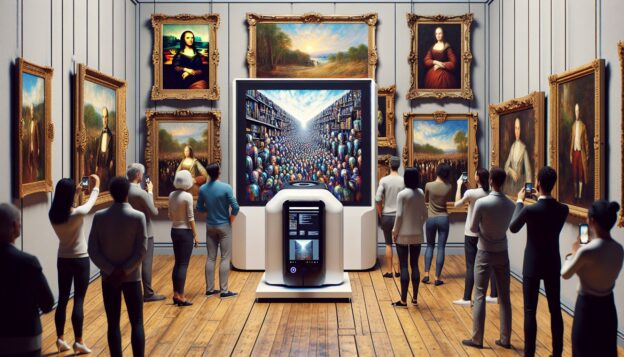
Hey tech aficionados and art enthusiasts! If you’re anything like me, you’ve probably spent countless sleepless nights down tech rabbit holes, only to emerge dazed and confused yet utterly fascinated. Today, I want to explore one of those mind-blowing intersections where technology doesn’t just enhance human creativity, but it partners with it—Artificial Intelligence in the Creative Arts. Grab a cup of coffee (or two), and let’s dive into this unexplored territory.
The New Renaissance Artists: Machines
Once upon a time (not so long ago), the notion of AI creating art would’ve sounded like science fiction. Yet here we are, living that reality. Picture this: machines painting like van Gogh, composing symphonies like Beethoven, or writing prose reminiscent of J.K. Rowling! And this isn’t just a future possibility; it’s happening right now. Let’s explore how AI is transforming the creative arts and why it’s so darn exciting.
The Birth of AI Art
Remember the first time you heard about AI art? For me, it was when I stumbled across Edmond de Belamy, the now-famous AI-generated portrait sold at Christie’s auction house. Created by the Paris-based collective called Obvious, this piece got hammered down for a whopping $432,500. Let that sink in. Almost half a million dollars for an artwork that doesn’t have a living, breathing artist behind it.
How is this sorcery possible, you ask? The short answer is neural networks. More specifically, a type called GANs—Generative Adversarial Networks. These clever mechanisms involve two competing networks: one generating ideas (the generator) and another evaluating them (the discriminator). It’s like having an eternal critic-editor relationship, achieving a level of creativity us mortals can only dream about.
AI Composing Music: Friday Night Jams by Machines
And it’s not just visual art that’s in AI’s crosshairs. Ever heard of Ava? She’s an AI that composes music. You might be imagining monotonous, robotic soundscapes, but Ava surprises even the most skeptical audiophiles. Using deep learning algorithms, she analyzes collections of classical music, and out comes rich, melodious symphonies. Talk about having a Mozart in the machine.
I remember coming across an Ava-composed piece in a dimly lit cafe during an open mic night. As I sat there sipping my overpriced latte, a melody floated through the air. It was emotional, deep, and somehow profoundly sad. When the host announced it was an AI composition, my jaw hit the floor.
Pixels, Brushes, and Code: The Tools of Modern Creativity
So how exactly are these AI-generated masterpieces created? Well, we’ve got a whole armory of digital brushes and pixels at our disposal. Tools like DeepArt, RunwayML, and even software from Adobe are built for AI-driven art exploration.
The process, as I discovered by tinkering with a program myself, involves coding environments that are surprisingly accessible even to non-tech-savvy artists. You feed these programs a variety of styles, flavors, and moods, and out pops… well, something incredible most of the time!
Implications of Bringing AI into the Arts
Democratizing Art
With great power comes great responsibility, right? That nerdy Spiderman wisdom holds especially true for AI in art. On the one hand, AI is dramatically changing the creative landscape. Skills that once required years of training and practice are now more accessible. Imagine a world where anyone can compose symphonies, paint lifelike portraits, or craft immersive stories. The barriers to entry for artistic creation are lower than ever.
Ethical Quandaries
Of course, every tech advancement comes with its own Pandora’s box of ethical puzzles. Should AI be held to the same expectations as human artists, scrutinized for cultural sensitivity or political correctness? Who even owns an AI artwork—the programmers, the machine, or whoever loaded the dataset? And here’s a juicy one: How do critics critique an AI’s work? I mean, do you say, “Gosh, the coding on this part really brings out the emotional vibrato?” That’s tech talk meets art chatter at its finest.
The Future: Co-Creation with AI
Predicting the future is always speculative, especially in this fast-evolving field, but it’s hard not to get excited about the possibilities. I see a future where human and AI collaboration is the norm in art and creativity—a shared canvas. The combination of human emotion and machine precision might just give birth to masterpieces we’ve only dreamt of.
AI: The Tool, Not the Replacement
To set the record straight, AI is not out to replace human artists. It’s a tool—a remarkable one—that amplifies what we do creatively. Leonardo da Vinci didn’t have a laser cutter or a digital paintbrush, but imagine if he had! AI can take the grunt work out of art creation, like replicating styles or optimizing permutations, freeing up the human mind for that unique spark of creativity.
A Call to Artists, Developers, and Dreamers
So here we are, folks. Standing on the cusp of a new artistic era, hand in robotic hand with our AI companions. It’s both exhilarating and mildly terrifying, the latter mainly because my computer can write better poetry than I can. But don’t be scared; be inspired. Let’s embrace AI as a new collaborator in our lifelong adventure through art.
Whether you’re Picasso’s great-great-grandchild or a coding wizard, there’s a space for you in this AI-driven renaissance. Let’s paint, compose, write, and dream—together.
Until next time, keep dreaming big and coding hard!