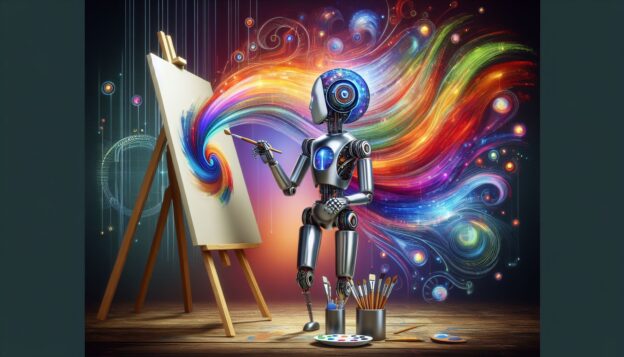
I’ve been around the tech block long enough to see trends come and go, but there’s something happening right now that makes my inner geek do the cha-cha. It’s about Artificial Intelligence stepping up its game in the creative realm. Picture this: a digital Picasso, an AI Shakespeare, or even a robotic Beethoven—all plugging away tirelessly in the corner of our digital workspace. If this doesn’t make you sit up and take notice, then maybe you should check if you might be a robot yourself!
Creative AI Just Got Real
Let’s rewind a little. Not long ago, AI was just about data crunching and pattern recognition. It was that super-serious kid at the back of the classroom who only spoke binary. Fast forward to today, and AI has thrown on a beret and started painting the Sistine Chapel. Well, metaphorically.
A Brush in Hand: AI’s foray into visual arts
Take a look at recent advancements in AI-generated art. Tools like DALL-E 3 from OpenAI and Google’s DeepDream can produce visuals that have gallery-goers doing double-takes. Sure, a human might say, “Hey, I could’ve done that,” but only after spending hours mulling over it and dealing with the occasional existential crisis.
AI in visual arts isn’t just about creating pretty pictures. It’s started an entirely new discussion about the nature of creativity itself. When you stare at a masterpiece, does it matter that it was created by a complex algorithm rather than a brooding artist? Or maybe that brooding artist is now just a very sophisticated piece of code? Either way, AI’s works are making waves, and the art world’s got its paint palette full trying to figure it all out.
AI Writes a New Chapter in Literature
And if you’re more of a booknerd rather than a gallery enthusiast, hang on to your bookmarks. AI is ghostwriting its way into the literary scene. Imagine algorithms mapping out complex plots and creating dynamic characters—without pulling any all-nighters!
We’ve got AI tools like GPT-4, which can spin a yarn and hold its own in literary circles. I recently read an AI-generated short story that had me reaching for tissues. Which raises a fascinating question: can a machine induce genuine emotion, or are we just projecting our own feelings onto its synthetic prose?
Creativity’s New Dance Partner
In this whirlwind relationship between humans and AI, we’re not being replaced. Instead, think of it as more of a dance between partners, where one doesn’t necessarily lead the other. AI is our new muse. It’s the fresh perspective our tired eyes didn’t know they needed.
AI and Human Collaboration
Take music, for instance. AI’s been composing symphonies in collaboration with human musicians. The Beatles might not be getting back together, but an algorithm could very well help write their next chart-toppers. Today’s composers use AI to generate novel chord progressions and complex harmonies, which they then weave into their compositions.
But here’s the thing: the best results still happen when human creativity and machine learning work together. It’s the alchemy that happens when ideas, pixels, and beats converge to birth something truly innovative. It’s a symbiotic relationship, where each party brings its strengths to the table, and the results can be genuinely mesmerizing.
The Road Ahead: Potholes and Promises
Don’t get me wrong; it’s not all rainbows and sentient unicorns. There are challenges ahead, and some skeptics out there might see AI as less of a collaborative partner and more of a competitor.
Ethical Concerns and Inevitable Missteps
Sure, unleashing AI creativity sounds thrilling—and mostly it is—but the ethical considerations can’t be ignored. If an AI creates an artwork or writes a bestseller, who owns the rights? If an AI offends someone with its creation, who is held responsible?
These questions might not have airtight answers yet, but they’re the conversations we’re starting to have as technology gallops forward. We’ve got to be realistic here. AI’s learning curve is steep, and it might trip up occasionally, sometimes at the worst possible moment.
A Philosophical Showdown
Plus, there’s the whole philosophical debate about the true nature of creativity. Can AI genuinely create, or is it merely remixing what us humans have already given to the world? Is there any creativity in remixing, or is it all just glorified repackaging?
Many traditionalists would argue that AI lacks the spark of human insight or emotion—which are quintessentially human. But in the grand scheme of things, does that even matter if the end result tugs at your heartstrings or inspires you to look at the world anew?
Conclusion: The Artistic Frontier
So where does that leave us? Well, I think of AI as our new artistic frontier—an uncharted territory of pure imaginative potential. It’s here, it’s growing, and it’s waiting to explore the limitless expanse of creativity alongside us. It nudges us to reconsider what it means to be creative, pushing the envelope far more than we might ever have dreamt of in the days of paint and parchment alone.
Right now, I can’t help but dream about the day I can proudly hang an AI-generated piece in my living room and read a novel crafted by a machine over a cup of coffee. We’re not surrendering our creativity, we’re merely expanding it through AI. As we strut into this brave new world, let’s remember to hold on to our creativity hats—but never too tightly. After all, why settle for the backseat when we could be right there in the passenger seat of this wild ride? Hold on, everyone. It’s going to be one heck of a journey!